


Nature of Flowers
Truncated Cuboctahedron: The Great Rhombicuboctahedron
Truncated Cuboctahedron: The Great Rhombicuboctahedron
Couldn't load pickup availability
The Truncated Cuboctahedron: The Great Rhombicuboctahedron
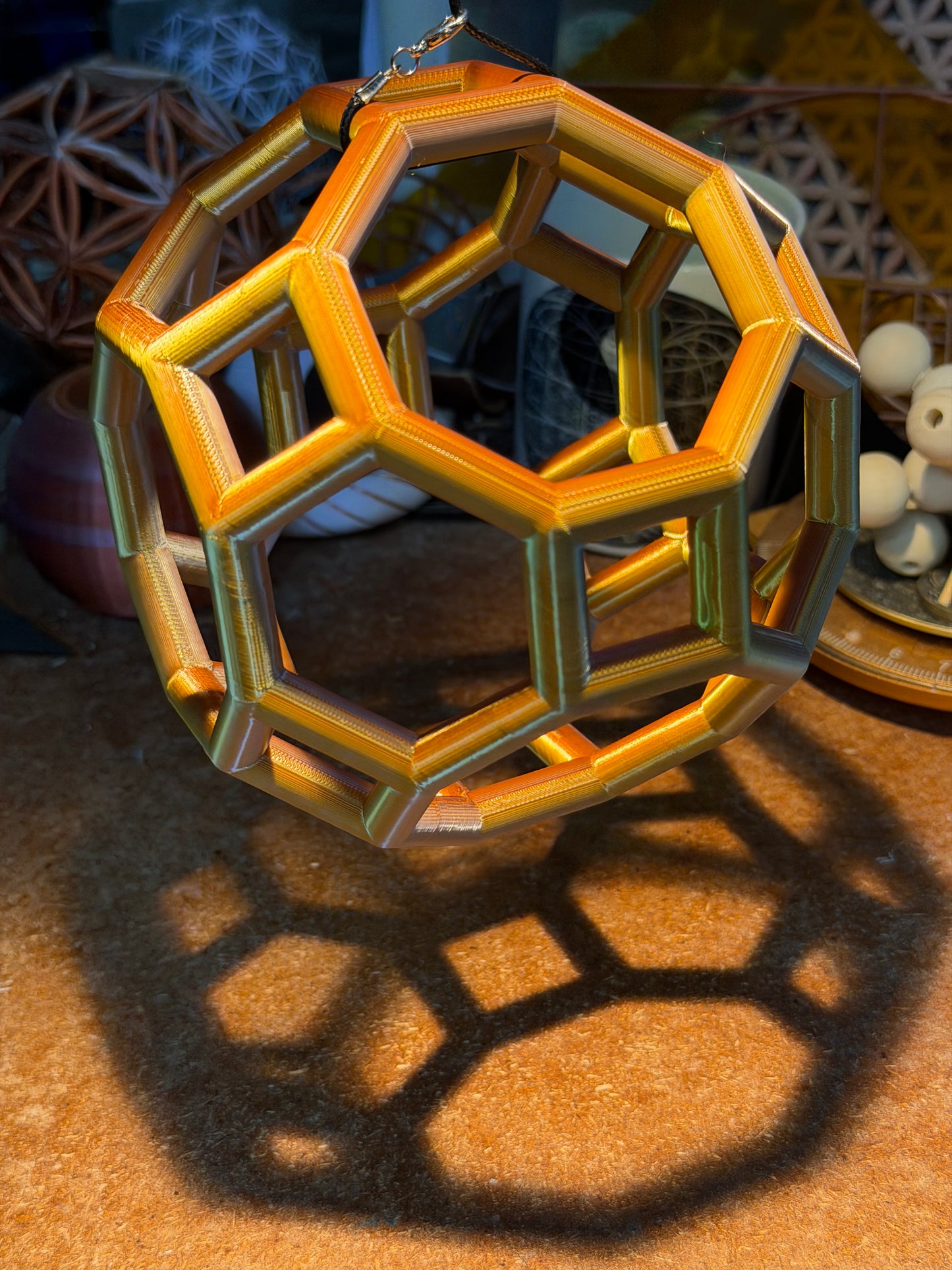
Command attention with the Truncated Cuboctahedron, the largest and most complex of the Archimedean solids that can be derived from the cubic family. This 3D-printed wireframe sculpture is a breathtaking display of geometric density, featuring a staggering number of faces that create a nearly spherical silhouette.
The Design Highlights
• High-Order Symmetry: An intricate lattice composed of 62 faces total: 12 regular octagons, 8 regular hexagons, and 30 squares. * Radiant Silk Finish: Printed in premium Silk Gold filament, the structure possesses a deep metallic luster that catches the light across its 120 vertices, creating a shimmering effect as you move around it.
• Ultimate Shadow Art: Because of its high face count and complex intersections, this model projects the most detailed and rhythmic shadow pattern of the cubic series, transforming any surface into a mathematical mandala.
• Uniform Series Scale: Precision-engineered to a consistent 1.5 inch (39.6mm) edge length, allowing it to tower in "volume" over simpler shapes in your collection while maintaining perfectly matching proportions.
Specifications
• Material: High-quality, eco-friendly Silk PLA.
• Structure: High-resolution 3D-printed wireframe designed for maximum structural clarity.
• Vertex & Edge Count: 120 vertices and 180 edges.
• Display: Features an integrated suspension point for hanging as a kinetic sculpture, though its broad octagonal faces also allow for stable tabletop placement.
The Mathematical Story
The Truncated Cuboctahedron is often called the Great Rhombicuboctahedron. It is a "zonohedron," meaning every face has a center of symmetry. In this model, you can see the culmination of the truncation process: by "cutting" the corners of a cuboctahedron, the squares become octagons, the triangles become hexagons, and new square faces emerge at every vertex. It represents the limit of how complex a solid can become while remaining within the cubic symmetry group.